Hello friends! For my first “real” post I want to talk about what is probably my household’s favorite game at this time. Emily and I love playing it, and Remy would love watching it if the birds the game revolves around were to come alive. That game is Wingspan. I want to take a look first at the basegame, but then to look at the expansions, Europe and Oceania, to see how the game has changed with them (As well as recommending when it would be a good time to add them!). The original plan was to discuss all of them in this post (As the images used will reflect), but it’s become quite lengthy with just the overview and discussion of the base game. I’ll be following up this week with a post about both expansions!
Before diving in, I want to give a brief overview of the game. I’ll briefly talk about the themes and mechanics that go into it. I’ll then discuss the base game, though not to as great a length as possible. Finally, I will post an additional entry discussing the expansions for the game.
Wingspan is a medium-weight engine-building game designed by Elizabeth Hargrave and published by Stonemaier Games. The stunning artwork – and it is stunning – is done by Natalia Rojas and Ana Maria Martinez. In the game, you play the part of a bird enthusiast who has to work to attract the best birds to your preserve. Each bird that ends up calling your preserve home will confer special abilities to you. Most of these abilities are activated when you take a turn on the habitat that the bird is located on, but there are several other ways that powers are activated and the expansions have added even more unique activation mechanisms. These habitats each allow the player to take a specific action and birds will have restrictions on them limiting what habitats they may live in.
The game takes place over 4 rounds, with each round getting progressively shorter. The first round starts with eight actions for each player and one action is “lost” each round, as the marker for that action is used in the scoring of round-end bonus objectives, which may range from “Eggs in your plains habitat” to “Birds with beaks facing to the right.” At the end of the game, you want to be the player with the most points. Your points will come from several sources, the primary ones being the point values of the birds that you have played, the eggs you have laid, the round-end bonus objectives, and your personal bonus objectives which are known only to you throughout the game.
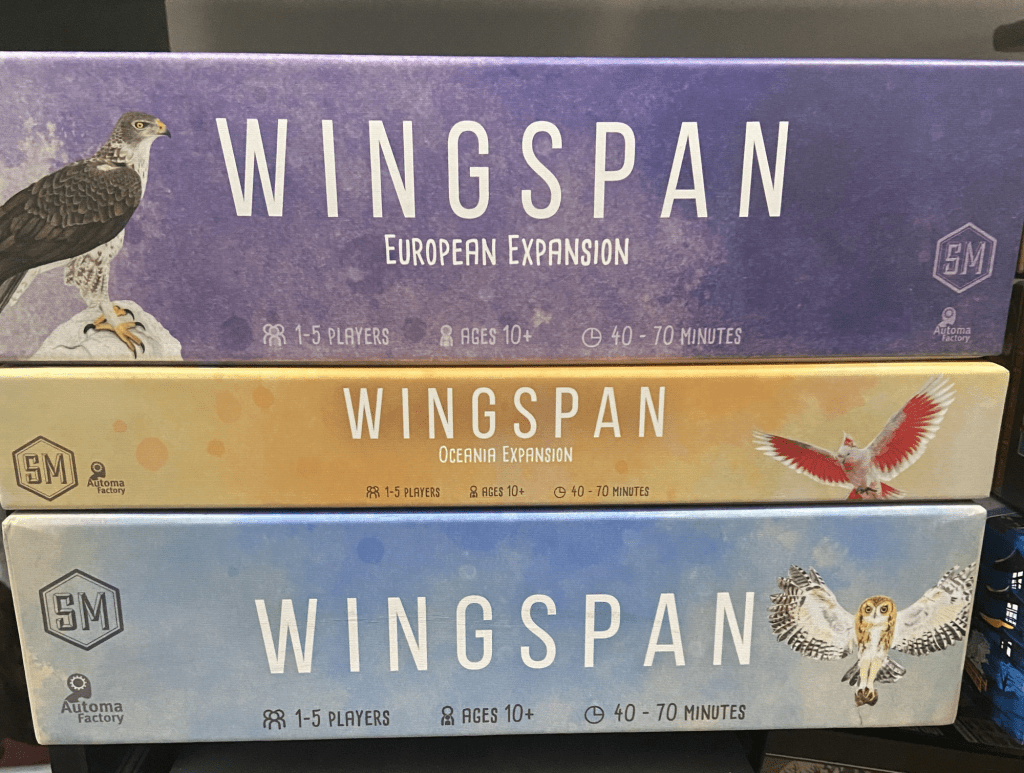
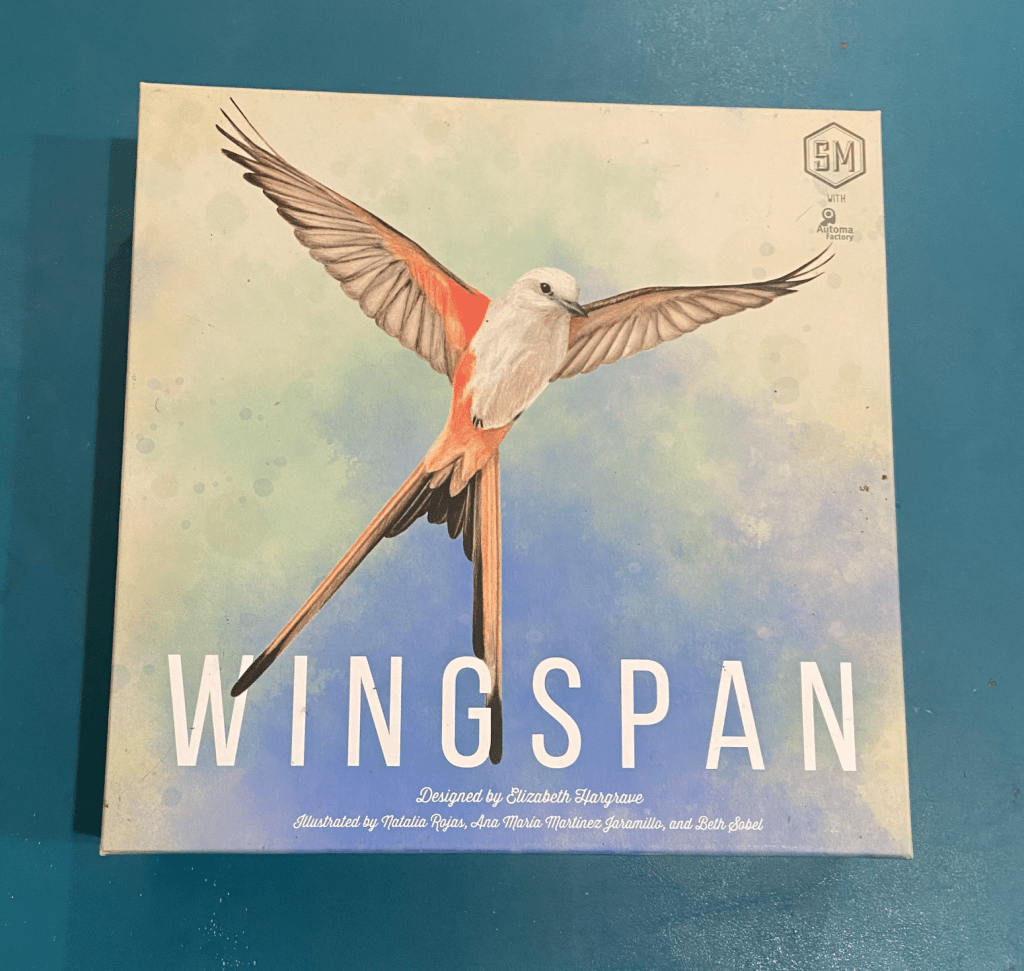
Wingspan – The Base Game
I will try to keep my discussion of the base game relatively short. There is almost nothing I can say about this game that hasn’t been said already. “The Big Blue Box,” as I like to call it, contains everything you need to start playing the game. On its own, this game is more than perfectly sufficient. I’ve pulled the following list from the Stonemaier games website (https://stonemaiergames.com/games/wingspan/) to let you know what’s included in this box:
- 170 unique bird cards (57x87mm)
- 26 bonus cards (57x87mm)
- 16 Automa cards (57x87mm)
- 103 food tokens
- 75 egg miniatures
- 5 custom wooden dice
- 5 player mats
- 1 birdfeeder dice tower
- 2-piece Game Trayz custom tray
- 1 goal mat
- 8 goal tiles
- 1 first-player token
- 40 action cubes (8 per player)
- 1 Scorepad (50 sheets; 1 sheet used for all players each game)
- 3 Rulebooks
This game can take a moment to set up. This is as true for the base game as it is for when you include expansions. Once you’ve got it pulled out and set up, however, the game looks incredible and quite approachable given the amount of pieces that it comes with. I love that the game includes a custom dice tower which looks like a birdhouse, as it adds just another layer of tactile fun to the game. Note that in images below, I’ve replaced some of the stock items with wooden variants. For the most part, this is simply because I prefer them and find that they add more organization to the game. It should be noted, however, that this is by no means necessary. The game actually has several small plastic trays that you can use to hold items and the cardboard elements are all sturdy and hold up to repeated use. The only exception to this is the dice tower. Because it is in multiple pieces and must be constructed each time, the joints may fray through repeated use. Overall, this is not terrible and if you’re playing the game enough to wear down that dicetower, it may be time to look into purchasing a sturdier one anyways!

The rules for the base game are fairly straightforward. Emily and I have found that they are easy enough to teach to newcomers that we rarely have to refer back to the rules book. Each player starts with five bird cards, one of each food, and two bonus cards. They choose one bonus card and discard the other. They will also choose how many birds they would like to keep, and return one food for each bird remaining in their hand (I like to summarize this to new plays as ‘You can only have five things’). After that, the core game play loop can be easily summed up as: Take an action (Collect food, lay eggs, or collect bird cards, or play a bird card), and carry out the actions listed on your birds in that row (if applicable). Repeat until the end of a round and score for that round’s bonus objective. Do it again 3 more times. Add up your points at the end.
This simple core loop hides a complex game with endless possibilities for strategies. Will you focus on simply amassing food to play high-value birds? Will you prioritize birds that will let you draw extra bonus cards? Or will you be the one who makes your group realize that gearing yourself toward laying eggs is really, really overpowered?
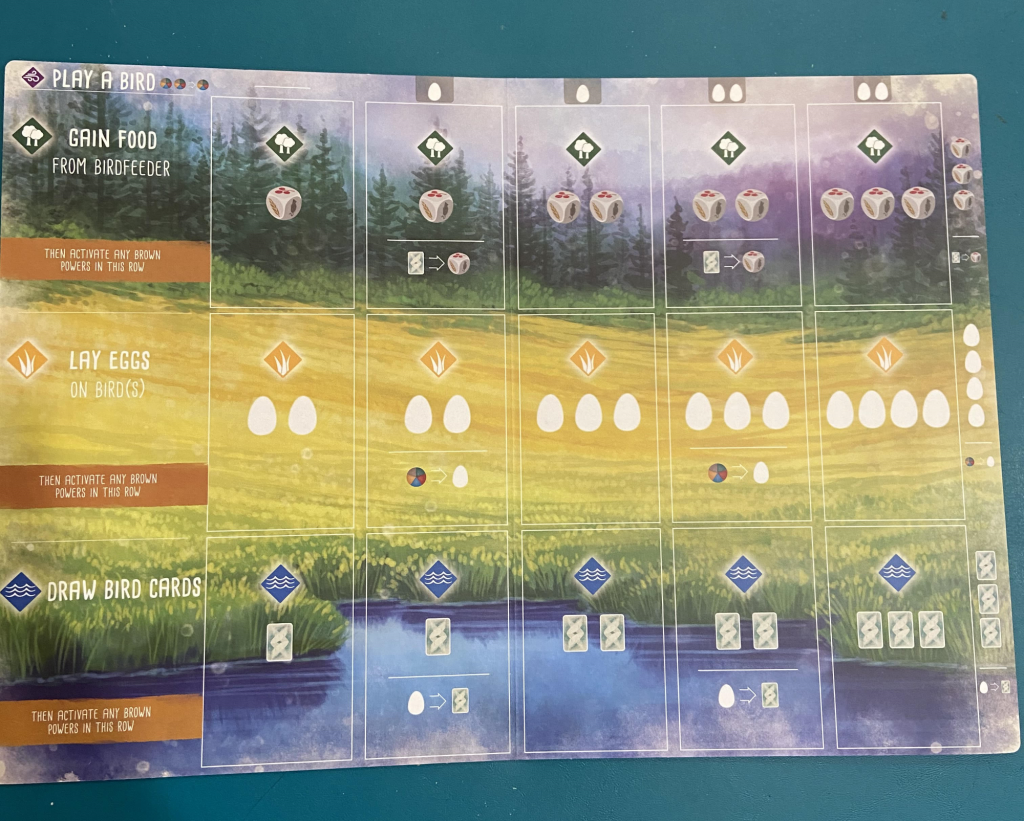
Where Wingspan really comes alive and becomes incredibly fun is when you have an engine built in a row (I’m a big fan of building up the Forest row) where you get to take several actions in a turn. Let’s set up an example below:
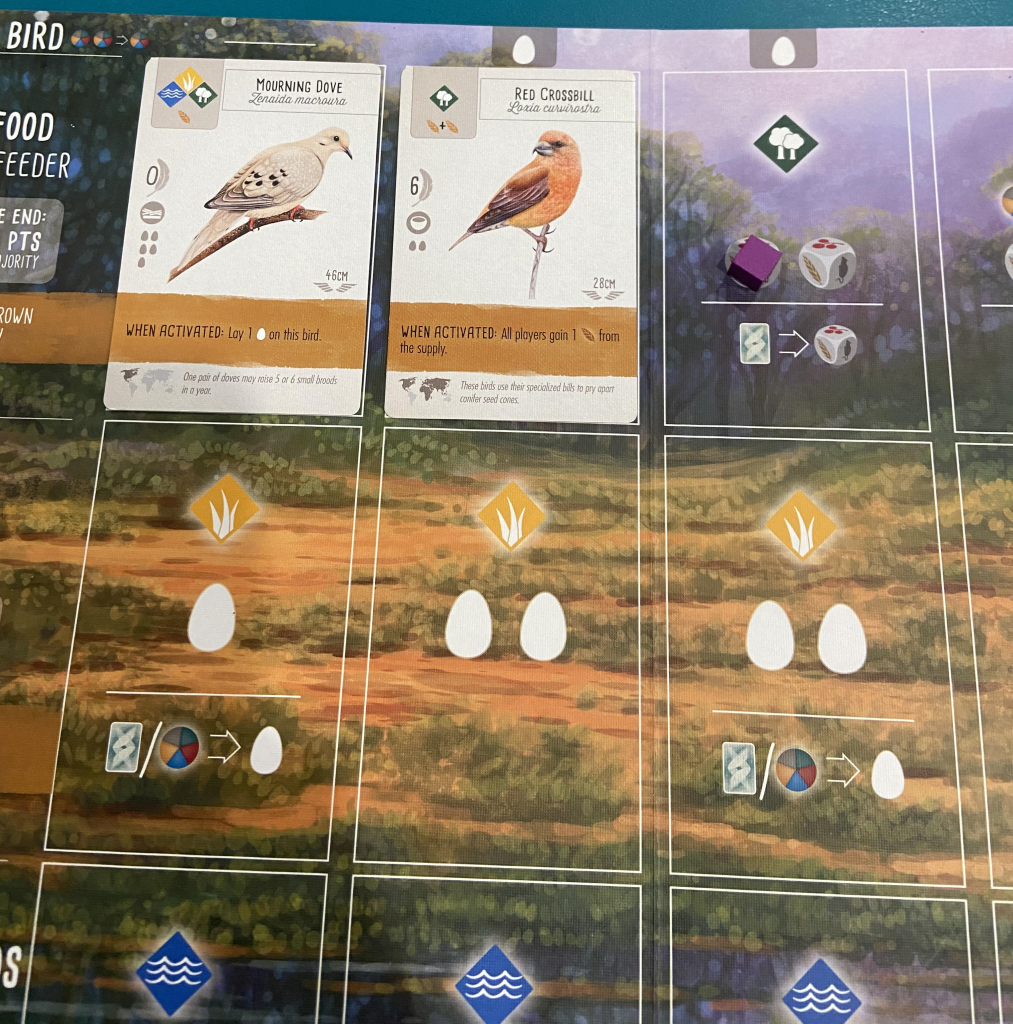
In this example, Purple has played their cube in the Forest track – Directly to the right of the most recent bird. This will allow them to take two food from the birdfeeder (Or, on the pictured Oceania board, they may also trade in a card from their hand to receive a third food). They will then move the cube to their Red Crossbill, who will allow each player to gain a wheat resource from the supply (which functions as the bank – This is an important distinction, as other cards will specify that you are limited to what is in the birdfeeder for similar actions). After each player has had their fill of one wheat, the cube moves to the Mourning Dove. This card will allow the player to lay an egg on it each time that cube goes over them, so the player would put an egg on their bird and then move their cube to the end of the track and pass play on to the next player.
Even in this minor example, we can see a few different ways this move could play out differently! Does the player really want everyone to gain extra food? Perhaps this would give another player the resource needed to add another bird – in that case, it may be best to ignore that top row and lay some eggs or draw more cards!
Overall, Wingspan allows you to try out a variety of strategies. The game is balanced incredibly well such that one strategy won’t necessarily be the one that all players are gunning for. High-point birds tend to be very expensive and/or lack abilities. Birds with amazing abilities (Such as the above mentioned Mourning Dove) may be expensive or they may not give the player very many points (Or none, in the dove’s case!) at the end, instead making them up through their impact on the game. Indeed, an egg each time you gather food would be quite the benefit!
The one exception to this is “The Egg Strategy.” Going back to the image of our original game board, you can see that laying eggs early gets you two eggs right away. Contrast this to food or cards, where you can only gain one. This imbalance carries throughout the track up until the very end and rewards players for specifically playing in the “field” habitat and taking repeated egg actions. In the base game, it was not uncommon for Emily and I both to spend the majority of the last round just laying eggs back and forth. At the same time, it made the beginning of the game drag as players could only grab one food or one card at a time. As you will see later, this issue does get rectified in the Oceania expansion.
Overall, I would give Wingspan a 9/10. This is an impressive game in terms of visuals, game play, complexity, and balance. The only complaints I have are some minor balancing issues (Which do get resolved later on!) and the deterioration of the cardboard dice tower – Of course, I don’t want to ding it too much for that as it has only degraded so much due to our love of the game.
I want to invite anyone to comment below with your thoughts! Will you be adding Wingspan to your collection? Do you disagree with something I’ve said about the game, or noticed any large omissions? Please also let me know what you do or don’t like about how I’ve written this up – As I’m new at this, any and all feedback is much appreciated!
 The Salem Gaming Trials