Hello friends and enemies! I’m back with another review of a board game. This time, I’m looking at something a little newer… Okay, it’s actually a *lot* newer. A few weeks ago, the Stardew Valley board game was announced and put on sale. We’re all big Stardew Valley fans in my household, so this is a game that we wanted to buy as soon as we were aware of it. I’m glad we did, since it sold out the very same day it went on sale and has not yet had a second printing announced (to my knowledge, at least). The game arrived last week and we gave it a couple of runs – One of which, as you will find out, was not exactly run correctly. At its core, this game is a cooperative worker placement game. While this board game isn’t the best one I’ve played by any stretch of the imagine, it has potential as a fun family game or a good game to break out with fans of Stardew Valley.
Pieces – The Game
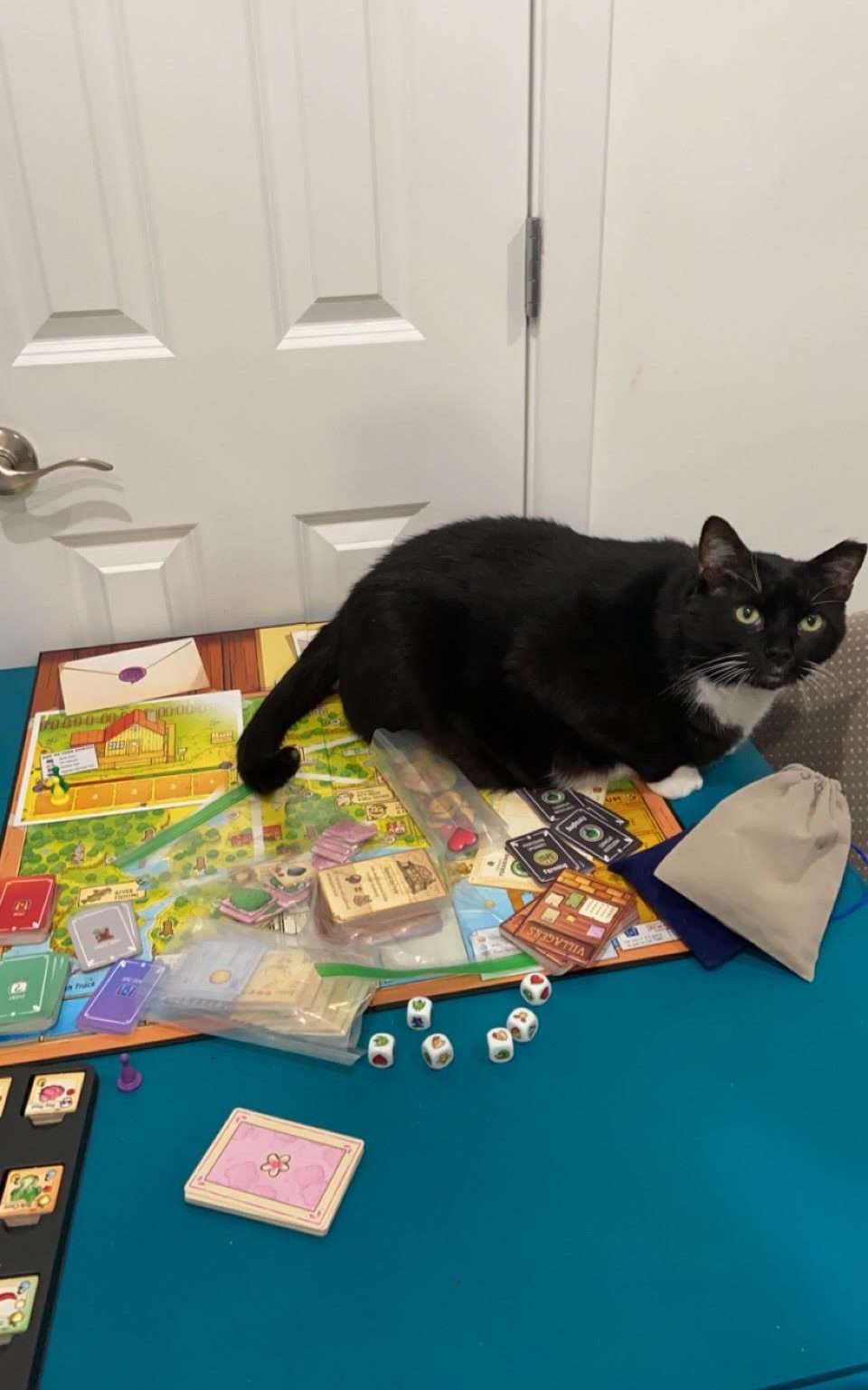
My first impression upon opening the box was that this would be “Pieces: The Game.” I’m no stranger to games with many pieces to pull out of the box (Hell, I run a 150-model 40K army!) so the sheer amount of pieces was not too offputting for me personally but may be daunting for a more casual gamer, who I believe this product is marketed toward. The vast majority of pieces are made of cardboard. To break it down, I’ve consulted the Stardew Valley website. Below, you will find a list of contents for the game. It seems that not all components are listed on the website or even in the rulebook, so I did also open up my box to check:
- 84 Season Cards (20 per season + the end of season card)
- 31 Villager cards (Including Krobus!!)
- 8 Grandpa Goals
- 26 Bundle Cards
- 19 Tool Upgrade Cards
- 50 Item Cards
- 48 Crop Tiles
- 60 Forageable Item Tiles
- 40 Double-sided Artifact/Mineral Tiles
- 24 Animal Product Tiles
- 16 Double-Sided Ore/Geode Tiles
- 60 Fishing Tiles
- 4 Stone Tiles
- 4 Bug meat Tiles
- 4 Player Pawns
- 1 Spouse Pawn
- 6 Dice – 3 of which are general-purpose and 3 of which are specifically for animals
- Double-sided First Player Token
- Gold Tokens in increments of 1, 5, and 10
- Heart Tokens
- Supply Tray
- Stardew Valley Board
- 2 bags for the Fish and Artifact/Mineral tiles
All of this comes together in an 11 3/4″ x 11 3/4″ x 3 1/4″ box. Unboxing it will take a while. Unfortunately, other than the supply tray for the crops and ores, there is very little in the box to assist with organizing everything. Your choices are to pack everything in the box loose or to use an army’s worth of plastic bags to keep things separated. Yikes.
Another unfortunate fact about all the components is that you likely won’t find yourself using everything, especially if you’re not in a 4 player game. But, you’ll still need to set it up. The most egregious offenders are the seasonal forageables. There are 15 per season and you only really need a few of them – And unless you choose to play in the least optimized way possible, you won’t even be collecting half of them in a smaller game.
On the plus side, these components all come together to make a game that feels like it’s in a living world. The changing seasons bring with them different crops and forageable items, just as in the video game. On top of it, the game is simply beautiful. It takes major inspiration from the original game it’s based off of and is a bright and cheery game.
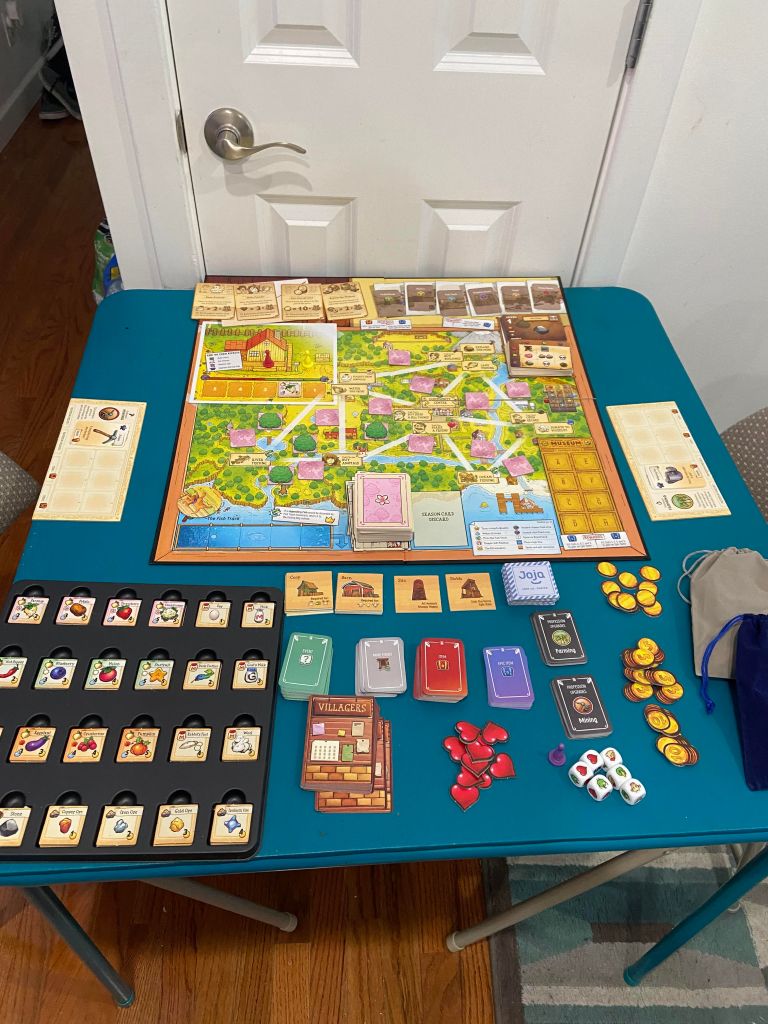
The objective of the game is to complete four of Grandpa’s Goals and 7 Community Center bundles. These are all randomly determined by the cards you draw which allows for the game to replayed with different objectives each time, sometimes requiring players to take on a vastly different playstyle than they normally would. You will set the game up by laying out those objectives as well as all of the various tokens, tiles, and cards you will need. To create your Seasons deck, you would draw four random cards for each season as well as the “Season End” card which would go at the end of each season. Don’t make the mistake that Emily and I did in our first game and skip this step. We accidentally ended up with a perpetual Spring and didn’t realize it until turn 12. We adjusted the deck after that, but the damage had largely already been done. Don’t be a fool like we were.
Once you’ve set the game up, each player will have a profession and a starting tool. These starting choices will be vital toward maximizing each round. For example, in our first game I chose the mining profession and the pick axe. My profession gave me access to specializations which would help me in the mines (Such as a Slingshot which would allow me to discard a stone to re-roll a monster in the mines). The tool will make a specific task easier or more fruitful – My pick axe would let me shift the mine tile I got to work on (These are decided by dice rolls, and the pick axe lets you choose an adjacent tile to your roll). Emily’s watering can would let her “Water” grow crops faster.
Once starting play, you’ll discover a lot of the systems of the video game have been abstracted to work within the board game. The translation was pretty good and the core gameplay loop is satisfying. Each turn has three phases – The Season Phase, the Planning Phase, and the Action Phase. The Season Phase has the first player flip a Season Card, which will reveal a series of symbols that can be beneficial, neutral, or harmful to the players. You may get a rainy day, which results in your crops being watered for free. You may instead get crows, which will eat a crop in the section matching their icon’s color. There are several other icons that may pop up and to describe them all takes about a page in the rulebook if I recall correctly.
The Planning Phase is pretty simple – While there are certain actions which may occur here, it is primarily for players to discuss their plans for the turn. This may seem pointless at first glance but it is super helpful in figuring out what you should be doing to maximize your actions as a team (For example, I may buy and plant seeds with one turn, which would allow another player to water on their turn. This is especially useful for the watering can player to plan around!).
Finally, the action phase: This is the longest phase and the one where the action happens, as implied by the name. In the action phase, players may choose to place their pawn in any of the locations on the board and either take two actions at that location or take one action, move to an adjacent location, and take a second action. If they pass a forageable item or tree, they may gather it as a “free” action. Pretty much everything you can do in the video game can be done here. The main actions you’ll be taking are buying/selling crops and seeds, planting them, watering crops, mining, fishing, revealing/completing bundles, and trying to make friends. You can also build, collect from animals, open geodes, donate to the museum, and buy animals.
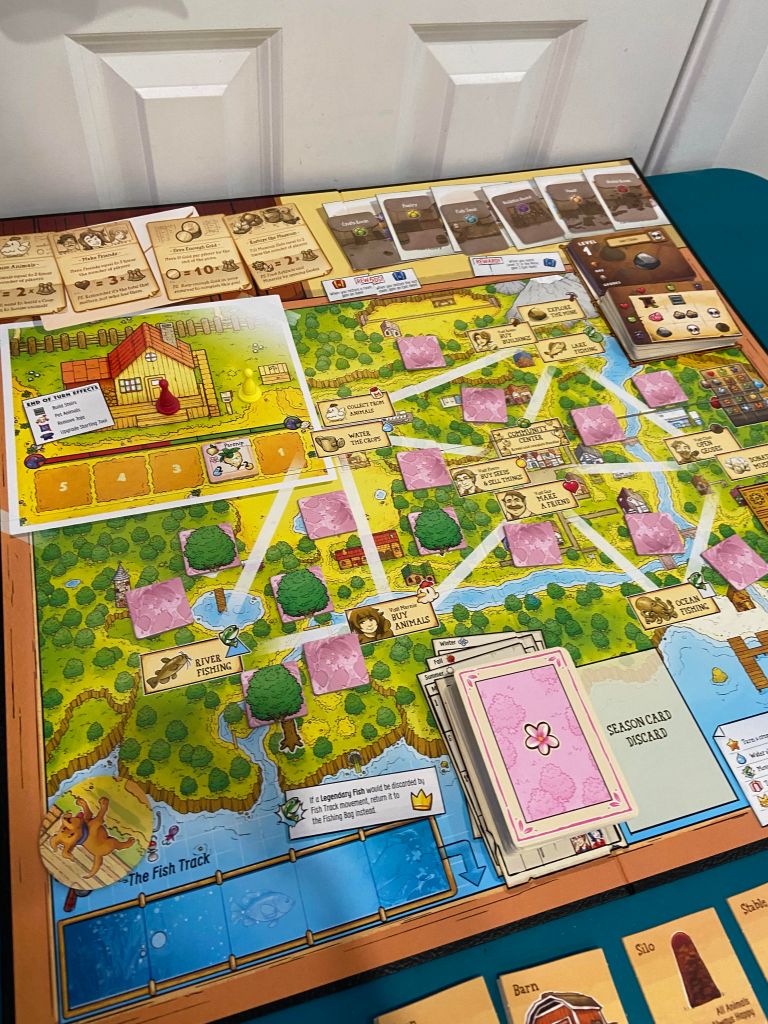
As you go about trying to complete your objectives, something will dawn on you: This game is hard. Like, really hard. This is due largely to the randomness of how the mechanics work. Mining, fishing, and gathering from animals all rely on dice rolls. You can end up going to the mines every turn and only ever coming out with stones if you get exceptionally unlucky. You may draw a potential friend only to see that they hate every item you have that you would have gifted them. After spending your hard earned hearts on revealing a bundle, you may realize that it’s impossible to complete if it requires crops from a previous season. In fact, the game even has a mechanic to deal with this. You can spend even more hearts to randomly draw another bundle! Better hope you get one you can use this time… The only core mechanic that doesn’t rely so heavily on RNG is planting and watering crops. Even that may get hit by bad RNG if you keep pulling crows, however.
This over reliance on RNG and the relatively small amount of actions players may take over the course of the game make it so that you really have to play perfectly to have a shot at winning. Even then, it may not be enough. I think that if the game were to lower the randomness a bit (For example, allowing more rerolls or reducing the consequences for having bad luck), it would be a much more enjoyable game. We’re no strangers to difficult games in my house and were able to actually beat it both times we played – however, the first time was because we ended up with a few extra rounds due to our Spring mistake and the second we admittedly fudged a bit at the end to slap down any egregiously bad RNG (We needed a mineral and a quality crop/forageable for almost a whole season to complete the game… Eventually we decided to redraw tiles if any more were available and the initial one wasn’t useful. We also cleared out three trash from the fish track when we needed a legendary fish, though we did not cheat to get the legendary fish itself). If two people who are experienced at playing games and really enjoy worker placement games need to fudge the game a bit, I can only imagine how unfun this must be to a more casual gamer or to children. At the same time – The game does start to drag at the end as you are really just running through the motions to try and complete whatever objectives have been eluding you. Extending each season by one or two days would be a good way to balance the RNG out as well, if not for this fact.
Once you’re all done with the game, it honestly feels anticlimactic. Truthfully, I was relieved to be free from the tyranny of agricultural labor and hard days in the mines once the game was over. The worst part had just begun though – and that was to put everything back into the box in its own Ziplock baggy. Or you could just dump it all in loosely, and I won’t blame you for doing so.
Overall, I think this is a game with a good core gameplay loop that just isn’t balanced well and leans too heavily on random elements. It’s a good novelty for fans of the video game who want to support Concerned Ape and I think with some good house ruling can be improved to the point of being a fun family game night type of game or a neat game to break out for friends who want a chance to play Stardew in a more tactile and social setting. Overall, I would give this game a 6/10.
 The Salem Gaming Trials
I love Stardew Valley (the video game) so much that I own it twice – originally got it for Xbox but then got a switch so needed it for that too. I also love cooperative board games, but I’m less keen on worker placement (although I think that is due to blocking by other players which I assume isn’t an issue as it’s cooperative). I’m quite intrigued by Stardew Valley the board game but wasn’t able to buy it first time round as it wasn’t released here in the UK. You say it is a bit too random which makes it frustrating, how would you compare it with other cooperative games? We really like Pandemic and Thunderbirds, also love Dawn of Peacemakers but that is much less well known. Would you say it is more random than those?
LikeLike
I unfortunately can’t say that I’ve played Thunderbirds or Dawn of Peacemakers, but I would say that compared to Pandemic, there is a greater amount of randomization, but to me it’s the way the randomization occurs that is the main issue. While in Pandemic, you do have the random element of where the different diseases pop up each turn and how fast the situation escalates, the actions you as a player can take don’t have a great amount of random chance. In Stardew Valley, you can choose to take an action and end up getting absolutely no benefit or very little benefit from taking that action if you have a poor roll or an unlucky card draw.
Blocking isn’t an issue in Stardew Valley, as multiple players can choose to take the same action(s) on the same turn. I do think if you’re a fan of cooperative games and of the video game, it could be worth a purchase with the caveat that you will need to be prepared to potentially enter into an unwinnable situation (It’s not every game that ends up like this, but it is much more frequent than I have run into in other games). Alternatively, I do think this game would be much less impacted by its random nature with the addition of a few house rules (In my house, we decided bundles would be visible to begin with – but to turn in what was required, you’d need the hearts that would have originally been required to reveal the bundle. This helps avoiding a situation where we don’t reveal a Spring Crop bundle in Summer, for example. I’ve also heard of interesting things that people do with the dice in the mines – such as rolling all three and choosing two dice for your mining outcome, where the rules as written would have you rolling only two).
LikeLike
That’s really helpful thanks. Hopefully our local boardgame café will get it and then we can test it out there before we buy! A lot of it does appeal to me. I don’t mind houserules to improve a game and yours sound very sensible.
LikeLike